 Central Mindanao University Academic Paradise of the South
Dean: JOSE HERMIS P. PATRICIO
Email: fes@cmu.edu.ph
- Overview
- Faculty and Staff
- Degree Programs Offered
- College Goals and Objectives
- Admission and Retention Policy
- Downloadables
CFES Overview
The College of Forestry and Environmental Science (CFES) traces its origins to 1963, when it was first established as a division under the College of Agriculture of Mindanao Agricultural College (MAC). The initiative was spearheaded by Mr. Eulalio Garduque, a Forest Ranger graduate of the University of the Philippines Los Baños, who also served as the first full-time faculty member handling forestry courses. In its early years, the program offered a two-year Forest Ranger certificate, initially enrolling 51 students. By 1964, the curriculum expanded to include a four-year Bachelor of Science in Forestry (BSF) program, reflecting the increasing demand for professional forestry education in Mindanao. A major institutional milestone occurred on June 19, 1965, when MAC was converted into Central Mindanao University through Republic Act No. 4498. This transition paved the way for the formal establishment of the College of Forestry as an independent academic unit on September 13, 1967, through Board of Regents Resolution No. 78.
The BS Forestry curriculum underwent several revisions in response to technological advancements and workforce needs. In 1970, the program was extended to five years, but it was later streamlined back to four years in the early 1970s after curriculum review. A terminal Forest Ranger program was also introduced to widen access, particularly for out-of-school youth. Graduate education was introduced in 1982 with programs in Forest Resource Management and Forest Biological Sciences, followed by specialization in Wood Science and Technology in 1996. These developments marked the College’s transition from a purely undergraduate institution to a center for advanced forestry education and research.In June 1997, the College broadened its academic scope by offering the Bachelor of Science in Environmental Science (BSES), signaling its shift toward interdisciplinary environmental education. This expansion ultimately led to the renaming of the unit as the College of Forestry and Environmental Science (CFES) in 2011.
The College introduced the Master of Science in Environmental Management in 2013, reinforcing its role in environmental leadership and sustainability education. The latest addition to CFES’s curricular program offering is the PhD in Forestry (major in Forest Resources Management), further strengthening its graduate offerings and its status as one of the leading forestry schools in the country. Today, both BS in Forestry and BS in Environmental Science programs are recognized as CHED center of excellence (CHED-COE) and center of development (CHED-COD), respectively.
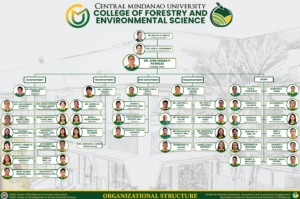
Organizational Chart
DEGREE PROGRAMS OFFERED
UNDERGRADUATE PROGRAMS:
- Bachelor of Science in Forestry
- Bachelor of Science in Environmental Science
GRADUATE PROGRAMS:
- Master of Science in Forestry (major in Forest Resources Management)
- Master of Science in Forestry (major in Forest Biological Sciences)
- Master of Science in Forestry (major in Wood Science & Technology)
- Master of Science in Environmental Management
- Doctor of Philosophy in Forestry (major in Forest Resources Management)
GOALS
The College of Forestry and Environmental Science has four goals, which are geared towards the realization of its mission and the vision of the University, to wit:
- Higher standard of excellence in instruction, research and extension for undergraduate and graduate courses;
- CMU College of Forestry as a center of excellence in Social Forestry,Plantations/Forest Management, Biodiversity and Environmental Management and Wood Utilization Technology in Mindanao;
- Full development of the qualification standards and expertise of faculty and staff of the College of Forestry; and
- Full development of instructional, research, extension and support facilities of the College of Forestry.
PROGRAM OBJECTIVES
The College of Forestry and Environmental Science has developed objectives by academic programs, which serve as a guide in conceptualizing, designing, planning and implementing various projects and activities towards the achievement of its four goals. These are as follows:
Bachelor of Science in Forestry
The main objective of the BSF program is to produce graduates who are competent and have high levels of integrity in promoting sustainable management of forest resources, ecosystem services, and the conservation of soil, water, and biodiversity. Graduates of the program must be able to:
- Conduct a comprehensive assessment and accounting of forest ecosystem services, resources, and social processes using appropriate ICT and related tools;
- Assess the impacts of climate change, risks, and vulnerabilities to prepare climate change adaptation, mitigation, and disaster risk reduction plans.
- Formulate, package, implement, and evaluate forest management-related research, development, and extension programs, projects, and policies;
- Interpret, assess, and formulate forest-related policies and laws; and
- Utilize traditional and modern tools, approaches, and methods, including IT, in problem-solving, planning, management, and other related activities.
Bachelor of Science in Environmental Science
The BSES program is designed to produce competent, ethical, and socially responsive environmental science professionals. Anchored on interdisciplinary scientific training and sustainable development principles, the program aims to:
- Produce environmental science graduates equipped with sufficient understanding regarding contemporary but relevant local, regional, and global environmental issues and problems;
- Generate professionals possessing adequate knowledge on their theories and technique needed to monitor, understand and manage quality environmental resources;
- Produce graduates who can apply scientific knowledge in a systematic approach from various disciplines;
- Develop the skills of students to employ a holistic approach to understanding and building solutions to an environmental problem; and Produce environmentalists, concerned with balancing economic quality with environmental resources sustainability.
Master of Science in Forestry
The primary goal of the MS in Forestry program is to produce graduates who possess technical and leadership capabilities, capable of critically analyzing situations and making informed decisions based on their scientific knowledge and skills in promoting sustainable management and utilization of forest resources and ecosystem services. Specifically, the program aims to:
- Train professional foresters with advanced scientific knowledge and analytical skills needed to understand ecological and social systems, particularly in the face of changing climate;
- Develop graduates’ ability to employ critical thinking and modern technologies to synthesize scientific information for wise decision-making in real-world challenges related to forest resource management and the environment; and
- Produce graduates who can design, implement, and evaluate research, development, and extension projects in the fields of forest resources management, forest biological sciences, social forestry and governance, and wood science and technology.
Master of Science in Environmental Management
The MS in Environmental Management (MSEM) program is designed to develop advanced competencies in environmental planning, policy analysis, and sustainable resource management. Grounded in interdisciplinary and applied approaches, the program aims to:
- Produce environmental management professionals who have a deeper understanding on the components, structure and processes of natural and disturbed ecosystems;
- Generate graduates who are highly skilled in environmental resource protection, conservation, rehabilitation and management so as to respond to the manpower needs of the environmental government agencies and private companies in the region; and
- Develop environmental specialists who can carry out independent scientific and technical research and assessments on local, regional, and global environmental issues and problems.
PhD in Forestry
The primary goal of the PhD in Forestry program is to produce graduates with higher competencies in developing new knowledge and can work independently to become leaders in academia, research institutions, government agencies or industry, driving innovations for sustainable forest and natural resource management. Specifically, the program is designed to:
- Equip professionals with leadership, advanced technical skills in information technology, AI and other innovative tools for original research and community engagement to create significant contributions to the scientific knowledge specifically in their area of specialization;
- Develop individuals who are capable of critically analyzing situations and can effectively apply, utilize, and share knowledge to solve issues and challenges for the benefit of the society; and
- Generate graduates who can work in a complex environment with full independence and competence to promote sustainable management and utilization of forest and natural resources.
ADMISSION AND RETENTION POLICY (Effective 1st semester AY 2025-26)
Admission requirement
- General Admission: Should satisfy the admission requirements of Central Mindanao University.
- For Entering Freshmen
- Graduate of Senior High School (preferably STEM)
- Should pass the Central Mindanao University – College Admission Test (CMUCAT)
- For Shiftees
- Duly approved shifting form
- Should have a GWA of at least 2.75
- For Transferees/Second Coursers
- Should pass the Central Mindanao University – College Admission Test
(CMUCAT)
- Should submit the following documents:
- Transcript of Records (TOR)
- Certificate of Good Moral Character
- Honorable dismissal
- Police Clearance
- Should have a GWA of at least 2.75 (or its equivalent) from PASUC/ACAP-member institutions or a GWA or better from other institutions (Reference: Univ. Code; Book 3; Chapter 12; Article 15, Section 1-d)Semester/academic year of effectivity:
Retention requirement
To continue in the program upon entering the third year, students must have a cumulative GWA of at least 2.75. Thereafter, students will no longer be required to maintain a specific GWA to remain in the program.
COURSE PROSPECTUS
BS Environmental Science 2023
